

Ask five dock suppliers how many floats you need and you’ll get five different formulas. Some say use 70% of the rated buoyancy. Some say 50%. Some skip the floats entirely and tell you to multiply square footage by 25.
They’re not contradicting each other. They’re all working backward from the same thing, and once you know what it is, the math stops being confusing.
The number that actually matters is freeboard
Freeboard is how far your deck sits above the water. That’s the thing you notice every time you use the dock - whether it feels solid and dry, or whether waves wash over it when a boat goes past.
For residential docks, the industry target is 12 to 14 inches of freeboard under normal load. High enough to stay dry in chop, low enough to step onto from a boat without climbing.
Every flotation formula you’ll find is just a shortcut for hitting that number. Which is why they look different but produce similar answers.
The critical thing to understand about buoyancy ratings: the number printed on a float is its capacity when fully submerged. A 24″ x 48″ x 12″ drum rated at 454 lb is holding 454 lb with its top surface level with the water.
A dock loaded to its floats’ rated capacity has zero freeboard from the floats themselves. That’s why nobody designs to the rated number.
How freeboard actually works
Your deck height above water is two things added together:
The part of the float above the waterline, plus the thickness of your frame and decking.
A 2x6 frame is 5½″ and 5/4 decking adds about 1″, so the structure alone gives you roughly 6½″ before the float contributes anything. To reach 13″ of freeboard, you need about 6½″ of float riding above the surface.
On a 12″ float, that means about half of it sits underwater - which is where the “50% of rated” rule of thumb comes from. On a 20″ float, the same 6½″ above water means 13½″ submerged, or about 68% - hence the “70%” version. Same target, different geometry.
Working out your own number
Step 1: weigh the dock
Dead load
Pressure-treated pine runs about 3.2 lb per board foot once treated. A 2x6 frame with 5/4 decking works out to roughly 9 pounds per square foot, hardware included.
A 4′ x 16′ dock is 64 sq ft, so about 575 lb. 2x8 framing or composite decking runs heavier - add 20–30%.
Step 2: decide your live load
People and gear
Figure 200 lb per adult, and think about the busiest day rather than the average one. Add anything permanent: a bench, a ladder, a kayak rack, a cooler that never leaves.
Most residential docks are designed around 2–4 adults at once on a small section. A dock you plan to entertain on should be sized for the crowd.
Step 3: check the freeboard, not the total
Where the dock sits under load
Take the total load, divide by the combined rated buoyancy of your floats, and you get the fraction of float depth that ends up underwater.
Multiply that fraction by the float depth, subtract from the depth, and add your frame plus decking. That’s your loaded freeboard. Aim for 12–14″.
The shortcut
If you’d rather skip the arithmetic, the rule of thumb most suppliers use is 25 to 28 pounds of rated buoyancy per square foot of dock - the higher figure for heavier framing. Multiply, divide by your float’s rating, round up.
A worked example
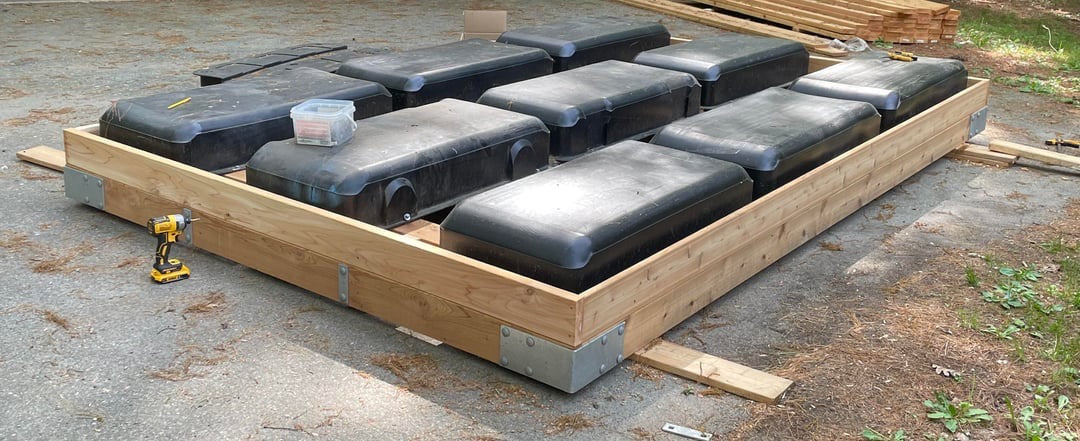
A 4′ x 16′ dock, 2x6 frame, 5/4 decking, five 24″ x 48″ x 12″ floats rated 454 lbs each.
| Dead load (64 sq ft at 9 lb/sq ft) | 575 lb |
| Total rated buoyancy (5 × 454) | 2,270 lb |
| Structure height (2x6 + 5/4 deck) | 6.5″ |
Empty, the dock uses about 25% of its flotation, putting 3″ of float underwater and leaving 15½″ of freeboard. Now load it up:
| Freeboard | Float submerged | Live load available | Adults |
|---|---|---|---|
| 14″ | 4.5″ | 280 lb | 1–2 |
| 13″ | 5.5″ | 470 lb | 2 |
| 12″ | 6.5″ | 660 lb | 3 |
| 11″ | 7.5″ | 850 lb | 4 |
| 10″ | 8.5″ | 1,035 lb | 5 |
Sanity-check that against the shortcut: 64 sq ft × 25 = 1,600 lb of buoyancy required, which is 3.5 floats. Five gives you meaningful headroom over the minimum, which is why it’s the standard spec rather than four.
Notice too that the dock doesn’t sink at 5 adults - it just rides lower. Freeboard degrades gradually, which is what makes it a useful design target rather than a pass/fail limit.
That exact configuration, in one box
Our 4′ x 16′ Floating Dock Kit ships with all five floats plus the complete galvanized steel frame hardware - corners, angles, washer plates, and every bolt set - for $1,259. Kits run from 4′ x 10′ through 8′ x 20′, each with the flotation already worked out.
See all dock kits Floats onlyDeeper floats do more work
Here’s something worth knowing before you order. Cost per pound of buoyancy at a typical 50% submergence, across the sizes we stock:
| Float | Rated | Price | Per lb |
|---|---|---|---|
| 24″ x 36″ x 12″ | 332 lb | $149 | $0.90 |
| 24″ x 48″ x 12″ | 454 lb | $179 | $0.79 |
| 24″ x 48″ x 16″ | 598 lb | $199 | $0.67 |
| 36″ x 48″ x 12″ | 700 lb | $224 | $0.64 |
| 24″ x 48″ x 20″ | 731 lb | $219 | $0.60 |
| 36″ x 48″ x 16″ | 925 lb | $249 | $0.54 |
| 36″ x 48″ x 20″ | 1,132 lb | $284 | $0.50 |
| 36″ x 48″ x 24″ | 1,364 lb | $319 | $0.47 |
| 48″ x 48″ x 24″ | 1,836 lb | $409 | $0.45 |
The 12″ series costs 30 to 70 percent more per pound of capacity than the deeper ones. If you want more freeboard or more capacity, going deeper is cheaper than going wider - and it means fewer floats to mount.
The constraint is water depth. A 24″ float needs enough water under it at your lowest seasonal level, plus clearance so it isn’t resting on the bottom in a drought year. On shallow shorelines the 12″ series isn’t a compromise - it’s the only thing that works.
Where the floats go
Placement matters as much as count.
Push the outer floats toward the ends. A dock with its flotation bunched in the middle see-saws when you walk to one end. Outer floats belong near the corners of the frame.
Keep it symmetrical across the width. Uneven side-to-side placement makes the dock list permanently, and it gets worse as the dock ages.
Bolt to the frame, not the decking. Flotation loads have to go into the structural members. PERMAFLOAT drums have cast-in mounting flanges for exactly this, and they want galvanized carriage bolts through the stringers with washer plates to spread the load. A bolt head pulling through wet pine is a slow leak of buoyancy you won’t notice until the dock lists.
Make sure the frame can take it. Flotation concentrates load at the mounting points, which is why cross joists need proper stringer angles rather than end-nailing. A frame that flexes works its float mounts loose over a season.
Compensate for anything heavy on one side. A gangway, a ladder, a bench at one end — add flotation under it rather than assuming the rest of the dock will carry it.
Replacing floats on an existing dock
Plenty of people arrive at this question the other way round — the dock already exists, and it’s sitting lower every year. A few things worth knowing before you order replacements.
Don’t assume like-for-like. If the dock rode low even when the floats were new, it was under-floated from the start. Replacement is your one cheap chance to fix that, since the labour is identical either way. Run the freeboard math above before you order.
Check the mounting geometry. Older drums used different flange patterns and spacing. Measure your existing mounting points before ordering, or plan on adding blocking to the frame.
Inspect the frame while it’s exposed. With the dock flipped or the floats off, you have access you won’t have again for years. Failed brackets, rusted-through angles, and loosened bolts are all far easier to replace now — and galvanized brackets and angles cost a fraction of what a second haul-out costs in effort.
Foam-filled beats air-filled. If your old floats were hollow and one of them failed, that’s the failure mode you’re replacing. Foam-filled drums don’t sink when punctured - they lose a little buoyancy and keep working.
Common mistakes
Designing to the rated number. That’s the fully-submerged figure. A dock at rated capacity is a dock at the waterline.
Forgetting the dock’s own weight. On a 4′ x 16′ it’s around 575 lb before anyone steps aboard - often the largest single load.
Sizing for the quiet afternoon. Docks disappoint on the busy day, not the average one.
Not accounting for what accumulates. Snow in northern climates. Lumber that gains weight over years in the water. The gear that gradually moves in and never leaves.
Saltwater note. Salt water is about 2.5% denser than fresh, so floats carry marginally more in it. Real, but not enough to change your float count - don’t design around it.
When in doubt, add a float
The failure is asymmetric. An extra float costs a few hundred dollars once. A dock that rides too low is something you notice every single time you use it, and retrofitting flotation to a finished dock means getting back under it in the water.
Want us to check your numbers?
Tell us your dock size, framing, how you plan to use it, and your water depth at its lowest point. We’ll work the flotation out with you. We’ve been manufacturing dock hardware in Rochester, New York since 1999.
Call 585-266-7920 Browse PERMAFLOAT drumsBuilding from scratch rather than adding flotation to an existing frame? Our complete dock kits ship with hardware and floats already matched to each size, and our guide to what a floating dock costs covers the full budget including lumber and freight.
Disclaimer. All calculations, figures, and recommendations in this article are provided as general reference only. Dock Hardware disclaims any and all responsibility for the accuracy, completeness, or functionality of the information above. Flotation requirements vary with site conditions, construction methods, materials, and use. For specific flotation requirements and dock designs, consult a structural engineer. Verify all local permitting requirements before construction.