

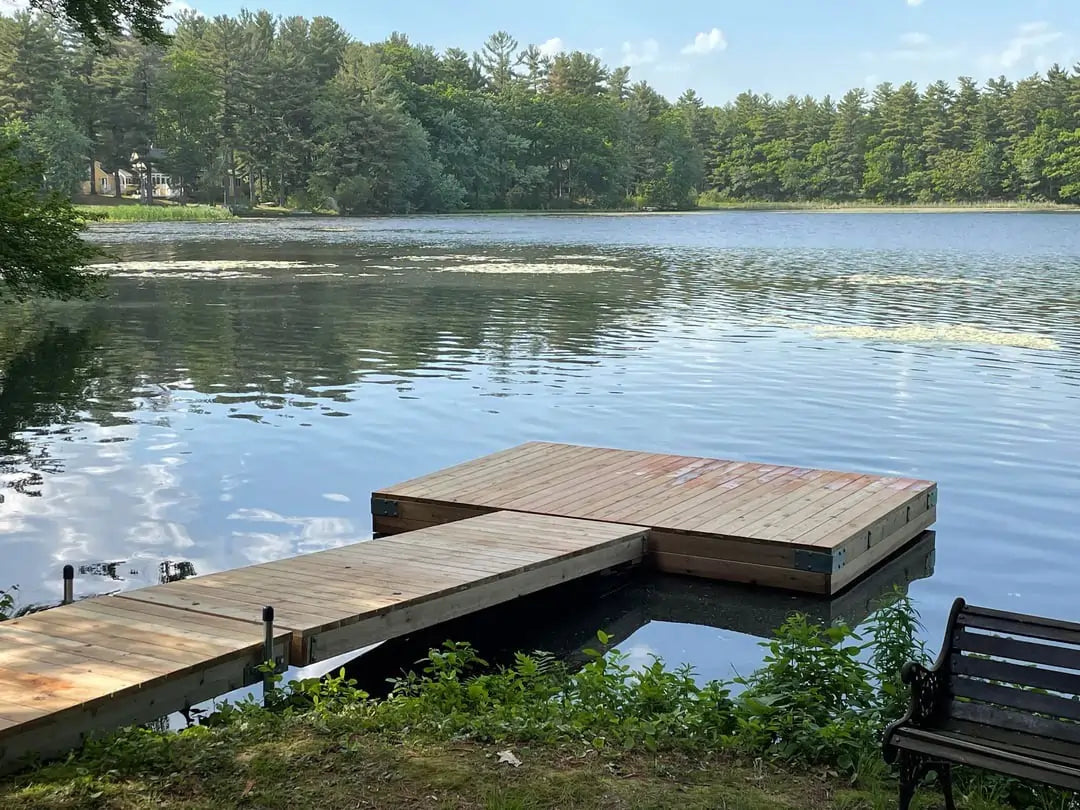
Search this question and you get ranges like “$2,600 to $21,000.” True, and useless. The spread is that wide because a floating dock isn’t one product — it’s a set of decisions, and each one moves the number by thousands.
This article walks through what actually drives the cost, what each approach realistically runs, and what people forget to budget for. By the end you should be able to put a number on your own project rather than a range on somebody else’s.
The short answer
Build it yourself and you’re paying for materials only. For a common 4′ x 16′ section — 64 square feet, big enough to tie up a boat and fish from — the hardware and flotation come to $1,259, and freight to a residential address runs $299 to $659 depending on where you are.
So $1,558 to $1,918 delivered, plus lumber. We’re not going to put a number on the lumber, and neither should anyone else — pressure-treated pine swings 20% or more between regions and changes week to week. What we can give you is the exact cut list, further down, so your lumber yard can price it in five minutes.
Have it built and installed for you instead and you’re into a different bracket. A straightforward floating dock install commonly runs $3,000 to $6,000 including materials, with dock builders charging roughly $40 to $100 per hour.
A note on per-square-foot figures. You’ll see floating docks quoted at $20 to $40 per square foot. That average is drawn mostly from larger installations and doesn’t scale down honestly — a contractor doesn’t charge a third as much to install a 4′ x 16′ as an 8′ x 20′, because mobilization, equipment, and a crew showing up cost the same either way. Treat per-square-foot pricing as a rough guide for big docks and ignore it for small ones.
What actually drives the price
Size
The most obvious factor, and it scales close to linearly. Doubling the length roughly doubles the framing, the decking, and the floats. There’s no meaningful economy of scale in a residential dock.
Floats
Usually the single largest line item, and the one people underestimate. Flotation is sized to the weight of the dock plus whatever you plan to put on it. A 4′ x 16′ dock typically needs five 24″ x 48″ x 12″ floats. Foam-filled polyethylene floats run roughly $150 to $200 each — ours are $179.99 — so that’s around $900 before anything else.
Cheaper options exist — drum floats, air-filled plastic — but they fail differently. Air-filled floats sink when punctured. Foam-filled ones don’t.
Framing and decking
Pressure-treated pine is the standard, and it’s the cost you cannot look up online with any confidence. Lumber prices swing 20% or more between regions and change week to week. Anyone quoting you a national figure for lumber is guessing.
Decking is where budgets stretch. 5/4 pressure-treated board is the economical default. Composite costs substantially more upfront and never needs sealing — which matters more on a dock than on a backyard deck, given the constant sun and water.
Hardware
Brackets, angles, plates, and bolts. Usually the smallest of the material costs, and the one where cutting corners costs the most later. Hot-dip galvanized steel is the minimum for freshwater; 316 stainless is what saltwater demands.
Freight
Anything with floats in it ships LTL freight rather than parcel, because floats are bulky rather than heavy. Depending on where you are, expect $300 to $650 for a single dock section shipped to a residential address. Sourcing floats locally can eliminate most of this, which is worth pricing out before you order.
Labor, if you’re hiring
Professional dock builders charge roughly $40 to $100 per hour, and a straightforward floating dock install commonly runs $3,000 to $6,000 including materials. Complex shorelines, deep water, or anything involving pilings pushes that up quickly.
The cost nobody mentions: permits
Most waterfront jurisdictions require a permit before you install a dock. Requirements vary enormously — some lakes need nothing more than an association notification, while navigable waterways may involve state environmental agencies and the Army Corps of Engineers.
Costs range from nothing to several hundred dollars, and timelines from days to months. Check before you buy materials, not after. A dock you have to remove is more expensive than any decking upgrade.
DIY or hire it out?
Build it yourself
You pay materials only. Realistic for anyone comfortable with a circular saw and a socket wrench — the frame is straightforward carpentry. Budget a weekend for a single section with two people. The hard part isn’t assembly, it’s getting it into the water.
Hire a dock builder
Worth it for large docks, difficult shorelines, deep water, or anything needing pilings. Also worth it if you’d rather not own the problem when a storm shifts your anchoring. Expect labor to roughly double the project cost on a small dock.
A middle path that a lot of people land on: buy the hardware and floats, build the frame yourself, and hire someone with a boat and a trailer for the install day.
A worked example: 4′ x 16′ floating dock
Numbers get useful when they’re specific, so here’s a complete build costed out with our own pricing. This is the most common single-section size — big enough to tie up a boat and fish from, small enough that two people can handle it seasonally.
What the frame takes
A 4′ x 16′ frame is two side stringers running the full 16 feet, two end pieces, and eight cross joists at 4 feet. Cut list:
2 boards @ 16′ — side stringers
10 boards @ 4′ — two end pieces and eight cross joists
The ten 4′ pieces cut from three 16′ boards, so you’re buying five 16′ boards for the frame, plus decking to cover 64 square feet.
Take that list to a lumber yard and you’ll have a real quote in five minutes — which is more useful than any number we could print here.
2x6 or 2x8?
Both work. 2x6 is lighter and cheaper, easier to build with, and easier to pull out in the fall. 2x8 is stiffer underfoot and stands up better to heavy use or choppy water, at more weight and more cost.
For a 4-foot span between stringers, 2x6 is adequate for most residential use. Note that 2x4 is generally too shallow — most dock bracket hardware is sized for a 5½″ or deeper board face, and a 2x4 won’t give the fasteners enough to bite into.
Hardware required
| Part | Qty |
|---|---|
| Outside corner brackets | 4 |
| Inside corner brackets | 4 |
| Stringer angles | 16 |
| Washer plates | 32 |
| Carriage bolt sets (½″ x 3″) | 96 |
| Lag bolts | 20 |
That’s the count for a properly braced 16-foot section. Fewer angles means more flex, which shows up as a dock that feels bouncy and works its fasteners loose over a season.
The kit math
Here’s something worth knowing before you order piece by piece.
Five floats at $179.99 each come to $899.95. Our complete 4′ x 16′ kit — every part in the table above plus all five floats — is $1,259.
That puts the steel in the kit at roughly $359, which is less than the same brackets, plates, and 96 bolt sets cost individually. The kit isn’t a convenience markup. It’s the cheaper way to buy.
It also removes the guesswork on quantities. Miscounting bolt sets is a common way to lose a weekend waiting on a second order.
Delivered cost
Add frame lumber and decking at local prices and you have your total. Compare that to $3,000–$6,000 to have a comparable dock built and installed for you — on a section this size, the labor costs roughly as much again as the dock itself.
Not sure what size you need?
We fabricate this hardware ourselves in Rochester, New York, and have since 1999. Tell us your water depth, what you’re tying up, and how you’ll use it — we’ll tell you what it takes. No obligation, and we’ll say so if a kit isn’t the right fit.
Call 585-266-7920 See all dock kitsWhere to save, and where not to
Worth economising on: decking material, if you don’t mind sealing it periodically. Dock size — people routinely build bigger than they use. Freight, by sourcing floats locally if you have a supplier nearby.
Not worth economising on: flotation, since undersized floats put your dock underwater when three people stand on one end. Hardware gauge and coating, since a bracket that rusts through takes the frame with it. Fastener count, since a section that flexes will loosen everything over time.
The pattern is that structure and buoyancy are where failure is expensive and repairs are difficult — you’re working over water. Surface finishes you can upgrade later.
Other sizes
The math scales predictably. A few reference points from our own kits, hardware and floats included:
| Size | Kit price |
|---|---|
| 4′ x 10′ | $799 |
| 4′ x 16′ | $1,259 |
| 6′ x 16′ | $1,419 |
| 8′ x 20′ | $2,549 |
Every kit listing includes a dimensioned drawing showing exactly how the hardware lays out, so you can work out the cut list for whichever size you pick.
If you already have floats, or want to source them locally to avoid freight, our Dock-in-a-Box is $232.99 for the steel alone — enough for a frame up to 16 feet, and it ships parcel rather than freight.
Budgeting your own project
Work through it in this order:
- Check permitting first. Before you spend anything.
- Settle the size. Be honest about what you'll use rather than what you can imagine using.
- Price the floats. Biggest line item, and it sets your freight cost.
- Price the lumber locally with the cut list above.
- Add hardware — and check the kit price against buying separately, because the kit is usually lower.
- Add 10% for the fasteners, tools, and the second trip to the hardware store that every project involves.
That gets you a number you can trust, built from your own inputs rather than a national average.
We manufacture dock hardware in Rochester, New York, so we have an obvious interest in this topic. The cut list, hardware counts, and flotation guidance above apply regardless of whose parts you use.