

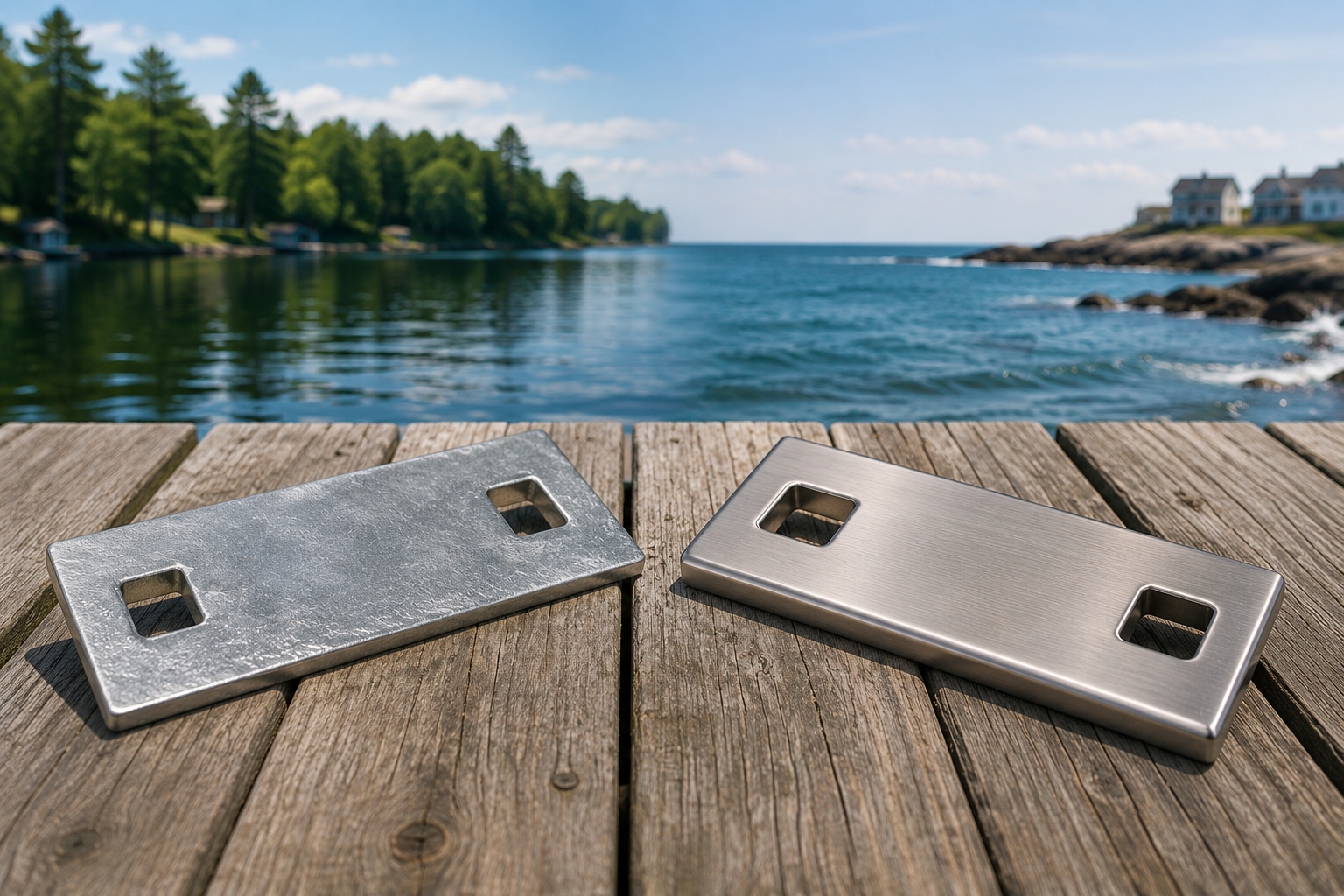
This decision gets treated as a budget question — galvanized if you’re economising, stainless if you’re not. That’s the wrong frame, and it leads people to overspend on one dock and under-build the next.
It isn’t about quality tiers. It’s about chemistry. The water your dock sits in determines which metal is correct, and for most people the answer is the cheaper one.
The short version
Fresh water
Hot-dip galvanized. In typical hard fresh water, galvanized dock hardware will outlast the lumber it’s bolted to — several times over.
Paying more here buys you nothing you’ll ever use.
Salt or brackish water
316 stainless. Chlorides attack zinc directly, and submerged galvanized steel in seawater has a measurable countdown on it.
This is where the extra cost buys something real.
The rest of this article is about how to tell which situation you’re in, and the handful of cases where the simple answer isn’t right.
Why galvanized works so well in fresh water
Hot-dip galvanizing bonds a zinc layer metallurgically to the steel. Zinc is more reactive than steel, so it corrodes preferentially — the coating is sacrificial by design, protecting the steel underneath even where the surface gets scratched or drilled.
In fresh water something useful happens on top of that. Dissolved calcium and magnesium deposit a scale of calcium carbonate and basic zinc carbonate on the zinc surface. That scale is a barrier, and it slows corrosion dramatically.
In hard fresh water with moderate alkalinity, zinc corrodes at roughly 0.5 to 2 mils per year — giving hot-dip galvanized coatings service lives of 25 to 75 years in continuous immersion.
Pressure-treated lumber in the same water is generally reckoned at 15 to 25 years. The hardware is not the part of your dock that will fail first.
The freshwater exception worth knowing
That protective scale only forms if there’s enough dissolved mineral content to build it. In soft water it doesn’t, and the numbers change substantially.
Soft, acidic water — pH below about 6.5, hardness under 50 ppm — corrodes zinc at 2 to 8 mils per year, cutting coating life to somewhere between 5 and 20 years. Water with high dissolved oxygen or heavy organic content behaves the same way.
There’s a second factor specific to docks: agitation. Wave action and current physically wash the carbonate scale off before it can establish, exposing fresh zinc to start over. An exposed, choppy site corrodes faster than a sheltered cove with identical water chemistry.
How to find out what your water is
You don’t have to guess. Lake associations often publish water quality data, state environmental agencies maintain testing results for most named waterbodies, and an inexpensive test kit will tell you hardness and pH in an afternoon.
If you’re on soft, acidic water with real wave exposure, that’s the freshwater case where stainless starts to make sense. It’s uncommon, but it’s worth ten minutes to check rather than assume.
Where galvanized runs out: salt water
Salt water is a different problem, not a harder version of the same one.
Chlorides react with zinc to form zinc chloride, which unlike zinc carbonate is highly soluble. It dissolves and washes away, continuously exposing fresh zinc. No protective scale ever establishes, so there’s no mechanism to slow the process down.
| Exposure | Galvanized service life |
|---|---|
| Hard fresh water, immersed | 25–75 years |
| Soft/acidic fresh water, immersed | 5–20 years |
| Coastal atmosphere, within a mile | 15–25 years |
| Seawater, submerged | 8–12 years |
Eight to twelve years is roughly half the life of the lumber. On a saltwater dock, galvanized hardware becomes the thing that fails first — and replacing corroded brackets on a built dock means dismantling it in the water.
Brackish water counts as salt
This catches people out. Tidal rivers and estuaries carry meaningful salt concentrations well inland — sometimes many miles from open ocean. If your water level rises and falls with the tide, you have salt water regardless of what the map suggests.
Intermittent salt exposure is not gentler, either. Wet-dry cycling concentrates chlorides as the water evaporates, which is why splash zones and tidal ranges are the most aggressive part of a marine structure.
Why 316 and not 304
“Stainless steel” on a spec sheet doesn’t tell you much. The two common grades behave very differently in salt water, and the difference is one element.
316 contains 2 to 3% molybdenum. 304 contains none. Molybdenum is specifically what resists chloride attack — the pitting and crevice corrosion that salt water causes.
304 is a perfectly good alloy in the right place. In a marine environment it pits, and it does so where you can’t see it: under washers, inside bolt holes, in the tight gaps between a bracket and the wood. A part can look sound and have lost significant section underneath.
When we built our stainless line we specified 316 throughout — brackets, connectors, backer plates, washer plates, and stringer angles. It costs more to make. In salt water it’s the grade that does the job.
316 is highly corrosion resistant, not immune. Crevice corrosion can still occur in stagnant salt water where oxygen is excluded — under fastener heads and in tight joints. It’s slow, and it’s a fraction of what galvanized experiences in the same conditions, but a marine dock of any material benefits from periodic inspection.
Don’t mix the two
This is the mistake that costs people the most, usually while trying to save money.
Zinc and stainless steel sit far apart on the galvanic series. Put them in contact in water — an electrolyte — and you’ve built a battery. The zinc becomes the anode and corrodes preferentially, and it does so fast, concentrated at exactly the contact point where the connection needs to hold.
So stainless bolts through galvanized brackets is worse than all-galvanized, not better. You’ve paid extra to accelerate the failure of the cheaper component.
Pick one system and stay in it. Galvanized brackets take galvanized fasteners. Stainless brackets take stainless fasteners. This applies to washer plates, backer plates, lag bolts, and carriage bolts — every metal part in contact.
What it costs
316 stainless runs roughly three times galvanized across comparable parts. Matched pairs from our own catalog:
| Part | Galvanized | 316 Stainless |
|---|---|---|
| Outside corner end | $14.60 | $45.00 |
| Inside corner bracket | $17.80 | $55.00 |
| Stringer angle 5″ | $4.20 | $14.50 |
| Backer plate 5″ x 5″ | $4.00 | $13.75 |
| T-male connector | $12.00 | $42.00 |
| T-female connector | $15.00 | $46.00 |
The clearest comparison is the same kit in both materials — identical part counts, identical frame, different metal:
On a saltwater dock, that $327 difference buys you hardware that isn’t the first thing to fail. On a freshwater lake, it buys you nothing you’ll live long enough to appreciate.
Making the call
Fresh water, normal hardness: galvanized. Confidently. Spend the savings on better decking or a bigger dock.
Fresh water, soft and acidic, exposed site: check your water chemistry. If hardness is under 50 ppm and pH is below 6.5, stainless is worth pricing.
Any tidal influence, brackish, or coastal: 316 stainless. Galvanized will work for a while and then it won’t, and the replacement happens in the water.
Whichever you choose: use it for every metal part in contact. No mixing.
Not sure which side of the line you’re on?
Tell us where the dock is going — the waterbody, whether it sees any tidal influence, and how exposed the site is. We’ll tell you which material we’d use, including when that’s the cheaper one. We manufacture both lines in Rochester, New York.
Call 585-266-7920 See the 316 stainless linePlanning a full build? Our guide to what a floating dock costs covers the whole budget, and how many floats you need works through flotation sizing.
Disclaimer. All figures and recommendations in this article are provided as general reference only. Dock Hardware disclaims any and all responsibility for the accuracy, completeness, or functionality of the information above. Corrosion rates vary with water chemistry, temperature, agitation, and site conditions. Service life figures are drawn from published industry data and are not a warranty of performance. For specific material selection on commercial or critical structures, consult a corrosion engineer.