

A floating dock has to do two contradictory things at once. It has to move — up and down, freely, with every tide and every seasonal water level change. And it has to stay put — not drift sideways, not swing, not twist out of line with the shore.
Chains and deadweights solve half of that. Pilings solve both, and they’re the standard answer in tidal water and anywhere the level swings hard. But a piling on its own does nothing. What matters is the connection between the dock and the pile, and that connection is where most of the practical detail lives — and where most of the available information doesn’t.
Your options, briefly
Chains and anchors
Cheapest and simplest. Concrete deadweights or helical anchors on the bottom, chain to the dock frame with deliberate slack so the dock can rise.
Works well in sheltered water with modest level change. Allows some drift and swing by design, and chains wear at the connection points.
Pilings
Vertical posts driven into the bed. The dock rides on them, moving vertically while held laterally.
The right answer for tidal water, big seasonal swings, wind exposure, or heavy boat traffic. More expensive up front, and the pilings need professional installation.
If you’re on a sheltered lake with a foot of seasonal variation, chains are probably fine. If you’re in a tidal estuary, on a river, on a reservoir with drawdown, or anywhere with real wind fetch, pilings are what the job needs.
How a dock actually rides on a piling
Here’s the part that’s hard to find written down anywhere.
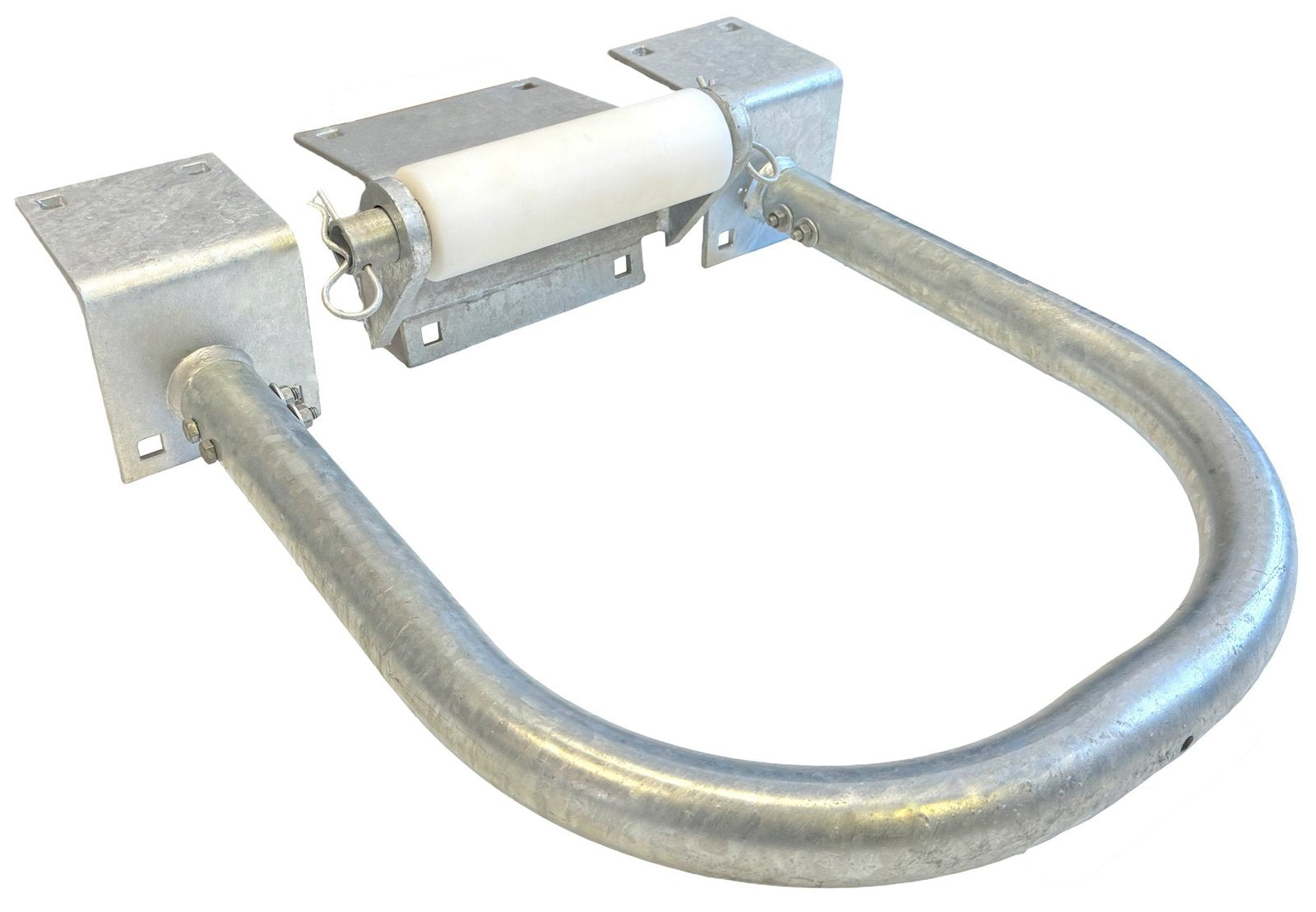
The dock doesn’t attach to the piling. It captures it. A steel hoop, mounted to the dock frame, surrounds the piling with deliberate clearance. The dock is free to travel up and down the pile, but can’t move away from it laterally.
A complete assembly is three parts working together:
What’s in a pile hoop assembly
- The hoop — a heavy-wall steel loop that encircles the piling. On our sets this is 1½″ Schedule 40 pipe, sized to the pile.
- Two mounting angles — welded plate that bolts the hoop to the dock’s frame members and transfers load into the structure.
- A UHMW roller — a plastic roller that bears against the piling, so the dock rolls rather than scrapes.
That roller is doing more work than it appears. Without it, every water level change drags steel across the piling. On a timber pile that abrades the wood; on the hoop it wears the galvanizing. UHMW is a low-friction, high-abrasion-resistance plastic — it takes the wear instead of the pile or the steel, and it’s the cheap part to replace when it eventually goes.
Sizing: the two-inch rule
This is the number people get wrong, and it’s the reason to read this section even if you buy your hardware elsewhere.
The hoop’s inside width should be about two inches larger than the piling diameter. A 12″ piling wants a 14″ hoop. A 16″ piling wants an 18″.
Too tight and it binds. Too loose and the dock has slop, which means impact loading every time it moves.
That’s the pattern across our full range:
| Piling | Hoop inside width | Set |
|---|---|---|
| 8″ | 10″ | DH-08-SET |
| 10″ | 12″ | DH-10-SET |
| 12″ | 14″ | DH-12-SET |
| 14″ | 16″ | DH-14-SET |
| 16″ | 18″ | DH-16-SET |
| 18″ | 20″ | DH-18-SET |
Measure the piling, not the spec. A “12-inch” timber pile is rarely exactly twelve inches, and it varies along its length. Measure at the point where the hoop will actually ride — typically around the mean water line — and measure the widest axis, since piles are seldom perfectly round.
If a pile is out of round or oversized, go up a size. Binding is the more expensive failure.
Why binding is the failure that matters
Everything about this system depends on free vertical travel. When a hoop binds or a roller seizes, the dock can’t rise with the water — and the water rises anyway.
What happens next depends on which is weaker. Either the dock is held down while the water comes up, submerging one corner, or the load transfers into the frame and starts tearing out the connection. Neither is a small repair, and both happen during weather rather than on a calm Saturday when you’re watching.
It’s also progressive. A slightly stiff roller wears unevenly, which makes it stiffer, which wears it faster. The time to catch that is early.
What to check each season
Pile connection inspection
- Spin every roller by hand. It should turn freely. Any resistance means it needs cleaning or replacing.
- Look for scoring on the piling where the hoop rides. Bright wood or gouged steel means something is dragging rather than rolling.
- Check the mounting bolts into the dock frame. These take cyclic load every time the water moves and they work loose.
- Look for red rust on the hoop and angles, particularly at welds and in the splash zone where wet-dry cycling is hardest on coatings.
- Watch the travel range. The hoop needs to stay on the pile at both extremes — highest water and lowest. A dock that rides up off the top of its pile is a dock that’s gone.
Placement and quantity
Two hoops is the practical minimum for a single dock section — one pile alone lets the dock pivot around it. Larger docks and heavier exposure want more, spread along the length rather than clustered.
Mount the hoops to structural frame members, never to decking. The lateral loads here are substantial: a hoop is what stops the whole dock from being pushed sideways by wind and wave, and that load has to go into the stringers.
Put hoops where the frame is already strong — at or near cross joists, where stringer angles tie the structure together. A hoop bolted to an unsupported span puts a concentrated cyclic load exactly where the frame is weakest.
Pilings need enough length
The pile has to extend above the highest water you’ll ever see, with margin. Storm surge, spring flood, and a bad-luck combination of tide and weather are all worth budgeting for — a dock that floats off the top of its pilings ends up somewhere else.
The reverse matters too: at your lowest water, the hoop should still be on the pile, well above the point where it could catch on anything.
Pile installation itself is a job for a marine contractor with the right equipment. Depth of embedment depends on the bottom, the loads, and local code, and it isn’t a DIY calculation.
Material choice
Pile hardware lives in the splash zone, which is the most aggressive part of a marine structure — constant wet-dry cycling, constant movement, constant abrasion.
Hot-dip galvanized steel is the standard for fresh water and holds up well. In salt or brackish water, the same material logic applies here as everywhere else on the dock — chlorides consume zinc, and this is the hardware you least want to be replacing.
Not sure what size you need?
Measure your piling at the waterline and give us a call. We fabricate these assemblies — hoops, angles, and rollers — in our Rochester, New York shop, in sizes from 8″ through 18″ pilings, and we can build to odd dimensions when a pile doesn’t match a standard size.
Call 585-266-7920 See pile hoop assembliesRelated reading: how many floats a dock needs, and winterizing and removing a floating dock — which covers what to inspect while everything’s accessible.
Disclaimer. All recommendations in this article are provided as general reference only. Dock Hardware disclaims any and all responsibility for the accuracy, completeness, or functionality of the information above. Piling installation, embedment depth, and structural load capacity depend on site conditions, bottom composition, and local code, and should be determined by a qualified marine contractor or structural engineer. Verify permitting requirements before installing pilings.