

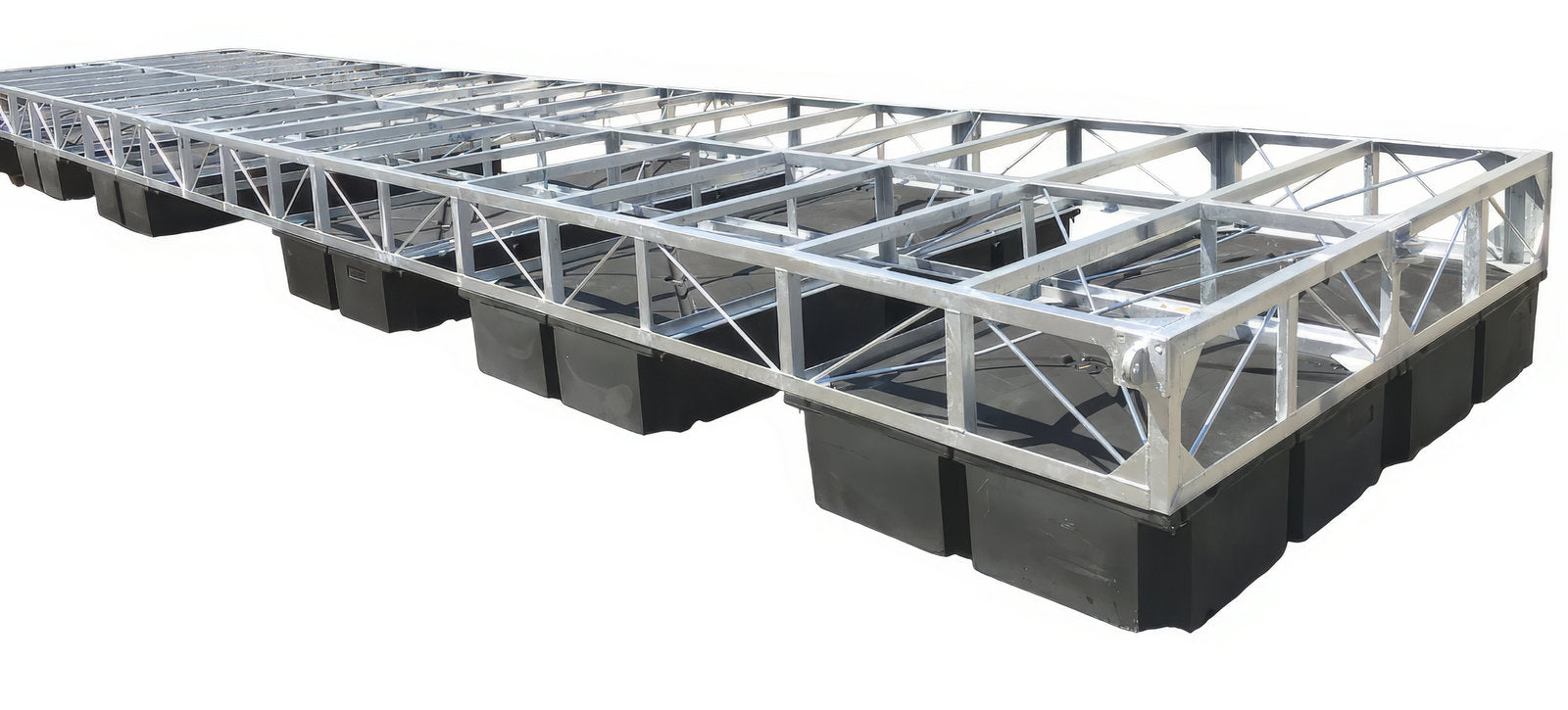
Aluminum truss docks have real advantages, and anyone who tells you otherwise is selling something. They’re light, they don’t rot, they need no sealing, and one person can move a section that would take two to handle in wood.
But there’s a property of aluminum that doesn’t show up in a spec comparison, and it matters specifically for docks in water that moves. It’s worth understanding before you choose a frame, whichever way you end up going.
Strength and stiffness are different things
Most material comparisons talk about strength - the load at which something bends permanently or breaks. By that measure aluminum does fine. High-strength alloys like 7075-T6 actually have a higher yield strength than common mild steel, so “steel is stronger” is too blunt to be useful.
Stiffness is a different property, and it’s the one you feel underfoot. Stiffness is resistance to bending under load, measured as elastic modulus, and it doesn’t vary much between alloys of the same metal.
Steel’s elastic modulus is roughly 200 GPa. Aluminum’s is roughly 70 GPa - and that figure barely moves across alloys, including the high-strength ones.
Same shape, same load, the aluminum member deflects about three times as much.
Aluminum designs compensate for this with deeper profiles, thicker walls, or added bracing. That works - it’s standard engineering practice. But it’s a design cost, not something the material gives you free, and it’s why an aluminum frame that matches a steel one for rigidity is bulkier than the weight difference suggests.
The property that matters in chop
Here’s the part that doesn’t come up in most dock material comparisons, and it’s the reason we build the way we do.
Steel has a fatigue endurance limit. Aluminum does not.
Fatigue is damage that accumulates from repeated loading and unloading - not from any single load being too large, but from the same modest load applied over and over. Steel has a stress threshold, roughly half its ultimate tensile strength, below which it can theoretically endure an unlimited number of cycles without accumulating fatigue damage. Stay under that line and steel simply doesn’t fatigue.
Aluminum has no such threshold. Its fatigue life is a function of stress amplitude and cycle count - every cycle contributes damage, however small the load. Aluminum’s fatigue strength is roughly half that of steel, and because of its low density relative to the loads it carries, engineering references specifically note that fatigue must be considered early in the design of aluminum structures, and that aluminum structures are prone to vibration.
Why this is a dock problem specifically. A floating dock in moving water is a continuously cyclically loaded structure. Every wave loads and unloads the frame. Every boat wake. Every person walking to the end and back. In a season on exposed water that’s an enormous cycle count at low stress amplitude - which is exactly the regime where the presence or absence of an endurance limit stops being academic.
A dock in a sheltered cove sees a fraction of those cycles. This is a chop problem, not a universal one.
Where each material makes sense
Aluminum earns its place
Sheltered water with limited wave action.
Docks that come out seasonally and need to be handled by one or two people.
Owners who want zero maintenance and will pay for it.
Salt water, where aluminum’s corrosion resistance is genuinely valuable.
Steel-and-timber earns its place
Exposed water, boat traffic, and sustained chop.
Anywhere ice movement is a factor.
Builds where repairability matters more than weight.
Budgets where the frame cost has to come down.
The repairability difference
There’s a practical argument alongside the metallurgical one, and for most owners it matters more day to day.
A welded aluminum truss is a single manufactured assembly. When something in it fails, you’re looking at specialist welding - aluminum welding is genuinely harder than steel, requires different equipment, and isn’t something most fabricators do well — or replacing the section.
A timber frame with bolted steel hardware is a set of parts. A corner bracket is $14.60. A stringer angle is $4.20. A stringer that’s gone soft is a board from the lumber yard. Every one of those is a socket-wrench job on shore, and every one is a repair rather than a replacement.
Over a twenty-year dock life, the question isn’t only which frame lasts longer. It’s what happens when part of it doesn’t - and whether that’s a Saturday morning or a phone call to a fabricator.
What we build and why
We manufacture hot-dip galvanized steel dock hardware, and we fabricate custom galvanized steel truss frames. That’s our answer to the same problem aluminum truss docks are solving, and we chose it for the reasons above: steel’s stiffness and endurance limit suit structures that live in moving water, and bolted assemblies stay repairable.
For most residential builds the timber frame with galvanized hardware is the right balance - it’s the most cost-effective route to a rigid dock, the materials are available everywhere, and any part of it can be replaced by the owner. Where a project needs more, we build the truss.
Weighing frame materials for your site?
Tell us how exposed the water is, what boat traffic looks like, and whether the dock comes out seasonally. We’ll tell you what we’d build - including when that’s not one of our kits. We manufacture in Rochester, New York and have since 1999.
Call 585-266-7920 See dock kitsRelated: galvanized vs. 316 stainless covers which metal suits your water chemistry, and what a floating dock costs breaks down a full build budget.
Disclaimer. Material property figures cited above are nominal published values for structural steel and common aluminum alloys, and vary with specific alloy, temper, and section geometry. All recommendations are provided as general reference only. Dock Hardware disclaims any and all responsibility for the accuracy, completeness, or functionality of the information above. Frame selection depends on site conditions, span, loading, and local code - consult a structural engineer for any dock where structural adequacy is in question.